North Water
The North WaterNorth Water is a remote northern seascape whose significance in the novel emerges through the labor and hazards of Arctic voyaging as well as through Patrick Sumner’s dream of drifting alone. It belongs to a world where ice is at once a route, a workplace, and a force capable of closing in on ships and crews.
Northern Approach and Sealing Grounds
The voyage north from Lerwick begins in prolonged fog, sleet, and bitter wind. Patrick Sumner remains sick in his cabin while gales strike the ship; only on the eleventh day does the weather ease enough for the crew to encounter scattered sea ice and glimpse Jan Mayen Island. Their preparations turn the voyage toward commercial work: rifles and ammunition are issued, and the men ready their knives for sealing. When they reach the main seal pack, the boats are lowered at dawn.
On the ice, Henry Drax works separately from the others, moving between groups of seals and preparing the skins for recovery. The five whaleboats return with their loads, and Arthur Brownlee counts the skins in terms of expected oil and market value. He estimates that four hundred skins could yield nine tons of oil, while competition from Dutch, Norwegian, Scottish, and English vessels presses the crew to keep hunting. These details present the northern ice not as empty wilderness but as a contested field of labor and profit.
Whaling, Labor, and Risk
The same commercial logic governs the handling of a whale. After measuring the carcass, Brownlee estimates its potential yield at ten tons of oil and at least half a ton of whalebone, worth close to nine hundred pounds if prices hold. Otto and Black climb onto the whale to strip its blubber and baleen; once the work is done, the crew receives an extra ration of rum. The landscape’s resources are converted, step by step, into cargo and anticipated income.
Patrick Sumner is assigned to carry heavy blocks of blubber from the foredeck and pitch them into the hold. The task is dirty and exhausting, and he nearly falls into the hold before Otto catches him. Yet completing the work gives Sumner a rare sense of physical satisfaction, and he sleeps without laudanum that night. The episode links the northern maritime setting to bodily effort and interdependence: the work is dangerous, but a fellow sailor’s intervention prevents a fall.
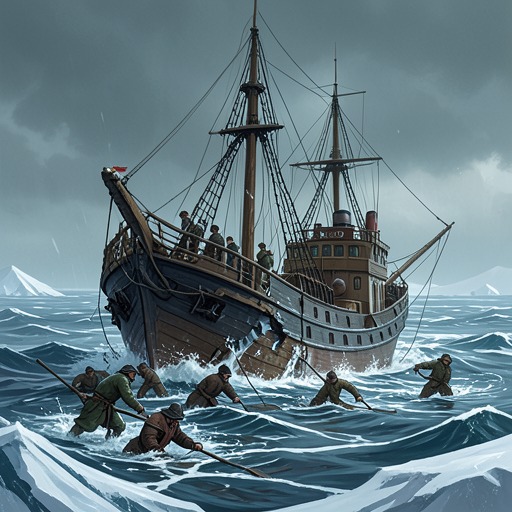
Ice also demands collective effort beyond hunting and processing. When a wind shift drives drift ice toward the ship, Cavendish orders the crew to cut an ice dock for protection. The men mark out the dimensions, rig pulleys and long saws, and divide into teams to cut through ice six feet thick. Their work produces large sections of floe, while the approaching pack closes its gaps and advances as a seemingly solid field. The scene makes the ice an active pressure on the ship, not merely a platform for extraction.
The North Water in Sumner’s Dream
The North Water is named in a dream in which Sumner finds himself alone in a leaky currach, afloat on an iceless expanse. He has no visible oars and sees no other vessel, yet he feels no fear. On an iceberg stands William Harper, the surgeon who found and took him in, appearing restored from the injury that had left him impaired. Sumner wants to ask how Harper has been made whole, but the currach has drifted too far away for his voice to reach him.
The dream sets solitary drifting against the strenuous, organized labor of the sealing and whaling passages. Its stillness offers no practical rescue or explanation: Harper remains beyond reach, and Sumner wakes back in the mission, where he discovers that the priest he treated is still alive. North Water therefore carries both the material pressure of the northern expedition and the distance, vulnerability, and uncertain hope expressed through Sumner’s dream.